
Dear Gardening Friends, Garden Travels and Thanks
Garden visits are back! It was such a pleasure to be on the road again. I love my home garden, but the call of others is strong. This month I will talk about my trip to Mt. Vernon, George Washington’s house and garden. Next month I will share my thoughts on Monticello, home of Thomas Jefferson.
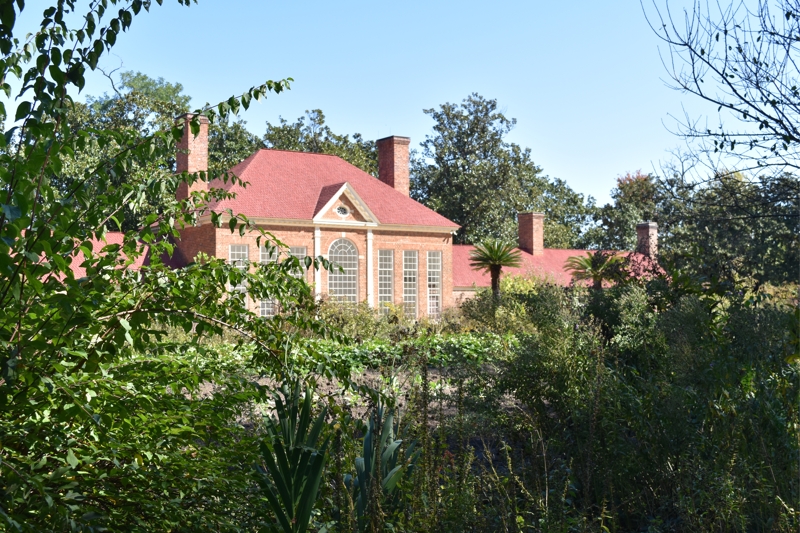
On a glorious, sunny autumnal day I arrived at Mt. Vernon just outside Washington D.C. I got there early so that I could get some photos without too many people in them. The garden is an interesting mixture of a true colonial garden overlaid by many generations of use.
The gardens and grounds were laid out by George Washington in colonial times. Its next major re-incarnation was due to the Mt. Vernon Ladies Association, one of the first and most influential preservation groups in the nation.
This second garden style is referred to as colonial-revival, as it echoes the original, but is in general more decorative, and refined. At the time they thought they were restoring the garden to its original form. It was the contemproray idea of what a true colonial garden would look like.
Two main formally designed areas flank the central lawn that has a vista down to the house and the Potomac River beyond. On either side of the symmetrical home there are informal walks that take you around the property and many outbuildings. Since I had limited time, I concentrated on the flower and fruit gardens on this trip.


The Lower Garden contains fruit, vegetables, and herbs arranged in patterns. Each section is outlined by borders of clipped herbs or low-growing espaliered apple trees. The Upper Garden is my favorite. It contains flowers and shrubs with vegetables “hidden” in the center of the flower beds. The reconstructed greenhouse overlooks the scrolled boxwood garden. The whole garden has an enclosed and protected feel that contrasts with the Lower Garden. Shrub and flower borders line the inside of the walls and fences. The plants in the wall-backed beds benefit from the added heat being thrown off by the wall. In the spring these have the earliest blooms.

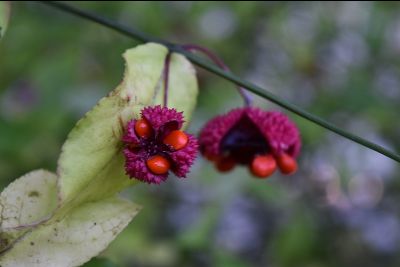
There were still plenty of plants in bloom or in fruit to enjoy. I love the shrub border of native plants including the Hearts-a-bustin (Euonymus americana) with its brilliant red fruit nestled into the pink case, the bright red berries of deciduous holly, and the lurid purple of the beautyberry.
Each time I visit I am drawn to a little garden house that is tucked in the back lefthand corner as you enter the garden gate from the house side. It is an octagonal shape and just cute. There is a set of wooden steps leading to the door and they look so inviting. Only once was the door open and I got to peek inside. I love seeing garden buildings in a landscape – it makes the garden seem inhabited. It sets in motion a gratitude for all the hands that have tilled the soil, planted the seeds, and picked the fruit. In the case of this garden, it has been a mixture of enslaved people and free, paid and volunteer. Centuries of work, care, and tending.

My grandfather was a farmer in Leicestershire, England. He worked on farms from when he was aged eleven until he retired. In those days plowing used horses. The horses needed cleaning, feeding, and stalls mucked out after a long day in the fields. It was a hard life and one that involved the support of the whole family. I do not want to take for granted that I will have food on my table and that people will work the fields. Even with mechanization, many types of farming still involve hands.
If you visit a garden this fall, I hope that you will take a moment to sit and contemplate the hands that worked the soil. In this season of thankfulness, I am thankful to all the people who work the land both in gardens and farms. Many of our lives are so far removed from what all our ancestors did – whether we had a choice or not. We all come from farming stock in recent generations or further back in our family history.

P.S. If you did not receive the previous newsletter, I am happy to send it to you—just drop me an email.
If you are reading this because it was passed on by a friend, and you would like to be on the list for this once-a-month email please drop me an email to sign up—you can always unsubscribe.
Old Friends and New Bookshops
I am gradually getting back to some in-person lectures and events. I was happy to be able to attend the Perennial Plant Conference at Scott Arboretum, Swarthmore College. It was such a great time to reconnect with friends and sign some books. Thanks to the Hardy Plant Society for doing the book sales.

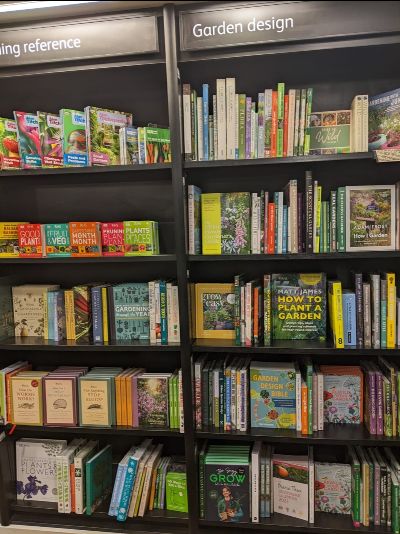
I love it when people send me photos of my books in different bookshops. This is at the Waterstones Bookshop in Piccadilly, London. Thanks to David Cato for this book spotting. Keep on sending them in to me—I would be happy to give you a shout out.
The Leaves Come Tumbling Down—
And Then What

What role do fallen leaves have in the garden? If you think of a natural woodland the leaves fall onto the ground and are then broken down by soil-borne organisms, and microorganisms. The complex interactions within the soil are vital to the health and growth of the plants that are growing in that soil. Without the yearly application of leaves to the soil the plants suffer.
This month, I dig into the when, whys, and hows of managing the bounty of leaves that are surely falling in your gardens this time of year.
Next month I discuss what books are on my winter reading list and why. You won’t want to miss this to know what you might want to ask for as a holiday present—or to buy for others as gifts.
November Star:
Tagetes patula ‘Frances’s Choice’

Tagetes patula ‘Frances’s Choice’ is a tall, slender marigold that is perfect for autumnal arrangements and mingles well with other plants. I grow them with dahlias, zinnias, celosia, and actually my tomatoes.
We grew the plants from seeds purchased from Select Seeds. We had good germination, but the plants were tiny for ages. I am not sure if they should have been started a little bit earlier than we did.

The Select Seeds website recommends starting them indoors 6 to 8 weeks before your last frost and then gradually acclimatizing them to outdoor temperatures after your last frost. They are a half-hardy, or warm-season annual so they cannot take cold soil or air temperatures.
What I love about these plants is that they are still blooming and have lots of new buds (as of this writing we have not had a frost). It seems that they need the cooling autumnal nights to trigger the best flower production. The center of the bloom is a brownish-mahogany with bright yellow surround that is great for fall arrangements. There is a pinwheel look to the flower.
The best part is the height of the plant. The packet says that the plants will be 2 to 3 feet. Mine are 3.5 to 4 feet tall in good compost-enriched soil with no added fertilizer. I did water them sometimes during the summer, but we had at least six weeks of no rain. The height means that you can cut nice long stems.

The ferny foliage is attractive enough to be left on for arranging. Just remember to take off leaves that would sit in the water because they will rot. The only slight negative for cut flowers is that they give off that characteristic marigold odor that some people dislike. I think that as long as you don’t have too much of it the smell just reminds me of days in the garden.
There are other similar looking marigolds that you may want to try next year. We also grew ‘Jolly Jester’, ‘Naughty Marietta’(short), and ‘Red Metamorph’. I am keeping my eyes open for other tall marigolds to try next year.
Book Club: Four Hedges –
A Gardener’s Chronicle
If you have loved my other book choices, you are going to want to read the book that I have chosen for you this month. It is another one that you may not be immediately drawn to as the images are in black and white. However, the charming woodcut artwork was produced by the author who was a woman ahead of her time.
Claire Leighton was an accomplished artist and author who was born and lived in England for the first part of her life and then emigrated to America in 1939. She produced incredible art throughout her long life and won many awards and accolades. This book is one small slice of her varied life.
The premise is simple—you and your partner buy a piece of land in the countryside and try to turn the meadow into a garden. Claire takes this rather mundane event and makes a little gem of a book that I have read several times (and marked up—in pencil). She begins in April which many gardeners in the Northern hemisphere take as the true beginning of the year.

The first sentence reads, “Ours is an ordinary garden. It is perched on a slope of the Chiltern Hills, exposed to every wind that blows. Its soil is chalk; its flower beds are pale grey.” This sets the scene and the tone for the whole book. Claire takes the “ordinary” and helps you to see beyond it to the extraordinary.
On a personal note, the first house that my husband and I lived in after we were married had a view over the Vale of Oxford to the Chiltern Hills. The house was rented and had single-paned windows that did not stop the winds that Claire describes, so I can relate to this.
As she was writing this, in 1930s England, the countryside life that she was chronicling was changing. Mechanization was being introduced and the old farming practices were disappearing. The woodcut that introduces the chapter for November shows two workers pushing a wooden wheelbarrow containing a tree. They seem to be leaning into the wind, their backs bent with the labor. Working the land was hard work and Claire shows this in the lines of her art.

Other woodcuts illustrate the simple flowers that she celebrates at the appropriate seasons of the year. The cowslips shown on the first page are near and dear to her and were growing in the garden. She explains that they were one of the reasons that they purchased that particular piece of land. One of my favorite illustrations is of the spiny-husked conkers that drop from horse chestnut trees at this time of the year.
The prose and the pictures show that Claire has a gift for closely noticing her surroundings. In this book she shares her astute observations with us through her gardening year. I hope that you will get a nice hot cup of tea, snuggle up under a blanket in your favorite chair and devour this book as I did.
Note: I am not sponsored to promote books found in these newsletters. They are featured because I truly love them.
If you like this newsletter, please tell your gardening friends about it. It is easy to subscribe by contacting me via my website.
If you would like to see photos of my garden at Northview and images of my garden travels, please follow me on Instagram @NorthviewGarden and @JennyRoseCarey
Bye for now,




Leave a Reply