
A Visit to RHS Garden Bridgewater
In usual Jenny Rose fashion, a chance meeting with gardener Andrea Graham in the wonderful Scrivener’s bookshop in Buxton, Derbyshire (a must visit – if you are in the area – five floors of used books), led to a lovely meet-up the next day at Bridgewater. Andrea is a gardener in the Trial Garden. She was kind enough to invite me to see what they are trialing at the moment including panicled hydrangeas, celery, melons, primroses, and my favorite heleniums. I look forward to hearing about the trial results.
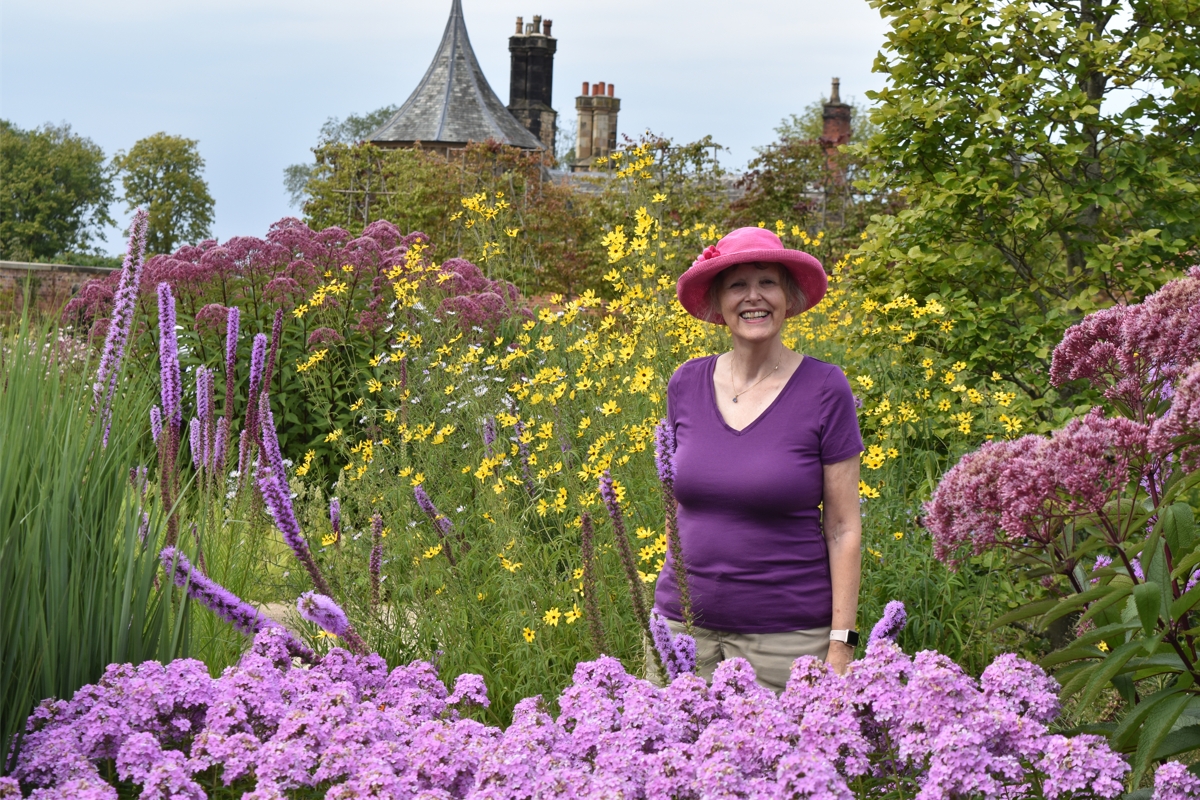
The large walled garden has a fantastic range of plants that were looking really good despite the hot and dry weather that England has had this summer. Many of my favorites were native to America, such as Joe-Pye weed, border phlox, and perennial sunflowers. The perennial plantings are given structure by upright columns of trimmed beech trees interspersed among the flowers. There are several large water features in the garden including an elongated rill with trickling water that delighted the children, and most grown-ups too.
A great big shout-out to Andrea and her fellow gardeners at RHS Bridgewater for a fantastic start to what will become an important garden.
P.S. If you did not receive the previous newsletter, which discussed the origins of our current wild gardening trend, I am happy to send it to you—just drop me an email.
If you are reading this because it was passed on by a friend, and you would like to be on the list for this once-a-month email please drop me an email to sign up—you can always unsubscribe.
Ultimate Flower Gardener’s Guide Available at Bridgewater
I have been excited by the reaction to my new flower gardening book The Ultimate Flower Gardener’s Guide. I was happy to see it for sale in the bookshop of the new Royal Horticultural Society’s Garden called Bridgewater. The garden is located in an urban area near Manchester, in northern England. The garden has only been open just over a year and I was excited to get a chance to see it now, so that I can return later to see how it grows, matures, and develops.


Creating Random Spontaneity in Your Flower Beds using Self Sown Flowers
One of the reasons that I am always drawn to old gardens is that they have that gentle, relaxed, lived-in look. Plants have had a chance to settle in and find nooks and crannies where they thrive and become part of the garden – not just an adornment to it. Much of this comfortable feeling has to do with self-sown, or volunteer, plants that seed themselves into cracks in paving, the bottom of a wall, areas of gravel, or even into flower beds.

Next month I will discuss digging up your dahlias to save them for the winter.
The blog contains useful techniques and photos of my favorite self-sowing flowers such as larkspur, poppies, and rose campion.
In the Garden: September Stars
This month I am sharing with you some photos of great looking dahlias that I have seen on my recent trip to England. Most of them come from a fantastic garden near Stoke-on-Trent in Staffordshire called Biddulph Grange. It is owned and operated by the National Trust, which owns many of the best gardens to visit. If you are thinking of a trip to England, I would join the National Trust or its sister organization in the U.S. called The Royal Oak Society.

Dahlias provide a fantastic variety of plant heights and leaf colors, flower shapes and sizes, and then the range of glorious colors with plenty of choice for every gardener. The only color that dahlias do not come in is blue, so they look great paired with blue salvias, which provide both a different color and a spiky shape to contrast with the primarily rounded dahlia flowers.
Left Image: Dahlia Fuchsia Ball
There was a time when dahlias had seriously gone out of gardening favor but now they are back with a vengeance. I have grown dahlias for as long as I can remember. I know that my Granny grew them in her garden as a cut flower for the ever-present arrangement on the dining room table. I just carried on that tradition.
Right Image: Dahlia Star Pink


Interestingly it was often the male gardeners who grew dahlias on the allotments. The large plants take up a lot of room and need staking and tending in a manner that is similar to growing vegetables. The dinner-plate dahlia flowers also lend themselves to horticultural competitions like the village flower show, with prizes for the largest leeks or potatoes and well as the largest dahlia flower.
Left Image: Dahlia Single Pink
The current dahlia growing trend has been largely driven by the Slow Flower movement of buying cut flowers from local farms near your home or growing them yourself. Once you figure out a few dahlia growing tips, you too will be able to grow prize-winning dahlias—at least enough to decorate your kitchen windowsill.
Dahlia plants grow from a small, unpromising tuber planted about five inches below soil level in the spring after the soil has warmed up enough that you would be planting tomatoes out. The larger plants are best grown in a bed by themselves in a similar way that you might grow vegetables. Alternatively, dahlias can be integrated in a flower bed, but they will still need staking because the stems are brittle. Short to medium height plants can be combined with perennials and annuals in a mixed flower bed and staked surreptitiously. Tall plants with large flowers are great at the back of a flower bed as a backdrop.


Dahlias are water-hogs and if you want the largest flowers and multiple blooms from the plant then you do have to keep them watered. In England this summer they have had two rather unusual heat waves, and very little rain for weeks. Gardeners have been saving every splash of water for their gardens including their dish-washing water. They don’t tend to have dishwashers in all homes so they have been throwing out the water from the washing up bowl that they use for washing the dishes. As one man who I was talking to said, ‘It didn’t seem to do them any harm’. I think that he is right—as long as you let it cool down first. Dahlias would be one of my first choices for the washing-up water.
Book Club: A Gentle Plea for Chaos


As unassuming as it is enchanting, the slim paperback of A Gentle Plea for Chaos is a great page-turning read. The author Mirabel Osler was an English country gardener who learned how to garden as she went along in partnership with her husband Michael. She espoused a style of gardening that is not for everyone because it is laissez-faire and a little wild. If like me you love that type of garden, it is a pleasure to read her insights.
What I love most are the little anecdotes that she throws into the narrative in an offhand, but I am sure totally planned way. I also treasure her descriptions and the joy in her discoveries that oozes from the pages. This is the way that she describes the spring-flowering Pasque flower (Pulsatilla vulgaris):
“One plant above all astonished me. When it appeared for the first time I could hardly believe that such an exquisite thing could emerge when the earth was still cold … I felt its pellucid amethyst flower and ferny soft leaves should be out somewhere in the wilderness.” (page 78)
There are so many lovely phrases and quotes. The quote at the top of this newsletter is just one of my favorites. She exactly captures my feelings about how some gardens that are very neat and tidy lack that quality that a hundred years ago might have been called “charm.” She says:
“Looking around gardens, how many of them could be said to lack that quality that adds an extra sensory dimension for the sake of orderliness? There is an antiseptic tidiness that characterizes a well-controlled gardener.” (page 12)
“Antiseptic tidiness”—what a great expression. Mirabel (a musical name) is also unabashedly opinionated about a range of gardening-related topics, including American gardens and writers (pages 91–97). What fun to agree or disagree with an author who shares her thoughts in a free-flowing way.
Note: I am not sponsored to promote books found in these newsletters. They are featured because I truly love them.
If you like this newsletter, please tell your gardening friends about it. It is easy to subscribe by contacting me via my website.
If you would like to see photos of my garden at Northview and images of my garden travels, please follow me on Instagram @NorthviewGarden and @JennyRoseCarey
Bye for now,




Leave a Reply