
Dear Gardening Friends,
As the garden outside slumbers and gradually shows some signs of new life I am looking forward to 2023. As I wait for the weather to improve, for temperatures to rise, and daylength to increase, I start to plan. I have been setting myself some garden goals for Northview.
2023 Northview Garden Goals

Study the patterns of light (and the sun’s heat) in the garden. I watch the sun in these shortest days to see which mini-microclimates are my sunniest and warmest spots These are the places where frost and snow melt first. These are good places to plant early spring bulbs next autumn. Bulbs in these warm spots will bloom first. The places where snow lingers are great for the final blooms of the season. I use microclimates to extend my spring flowering season.

Grow as many things from seed as possible. Growing plants from seed has a small carbon footprint. You will find that there is wider choice of seeds than there of starter plants. You can make decisions what type of seed to buy. For example, there are organically grown, open pollinated, or heirloom seed. For an easy method to start cold-hardy annuals and perennials, see the blog below about winter seed-sowing in milk jugs.
Make plentiful notes about why I like certain plants. I love to look at flower colors and fragrances. I can study leaf quality and form. In the winter I can sit down with the notebooks and look at my photos to plan for the upcoming gardening season.
Enjoy my garden more as in the quote from Elizabeth Lawrence at the top of the page. Drink more tea in the garden, watch bees buzzing, and breathe the air.

Look carefully at which species and cultivars perform well in my garden. This ties in with the goal above that is about aesthetics. This goal is about evaluating plants that grow healthily and strongly as well as have other superior qualities. Once I figure out which ones do well, I can propagate or buy more of them. This has the added benefit of making my garden design cohesive by repeating certain plants.

Garden Visits
Wing Haven and Elizabeth Lawrence’s Garden
These two gardens are located on the same street in Charlotte, North Carolina. They are both open to the public and owned by one organization, the Wing Haven Foundation.

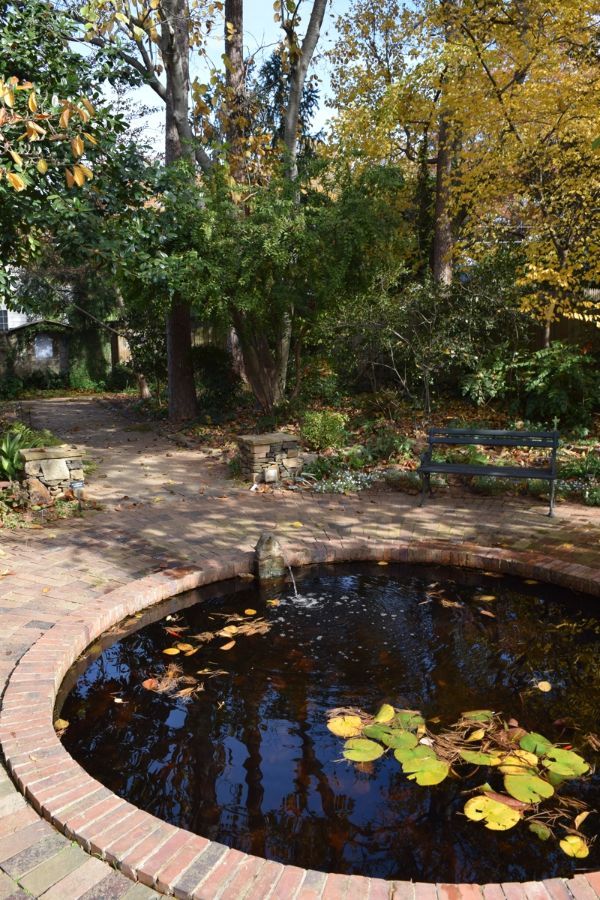
Wing Haven was the home of Elizabeth and Eddie Clarkson. They designed their garden for beauty but also for the birds. Today it lives up to its name of “Wing Haven” as an oasis for all our feathered friends. A particular feature of the garden is that there are water sources in many parts of the property. My favorite is a bird bath with a dripping tap to keep the water fresh and moss growing beneath it. The brick paths divide the garden up into rooms and provide shelter and nesting habitats for birds. A winter visit includes some lovely blooming camellias.
A few houses down the street you can also visit the garden of Elizabeth Lawrence who was a garden writer (see quote above and book review below). She used her garden as her experimental area and then wrote about the results. It is packed with plants, many of them rare or unusual. It is a gem of a garden.
Here are a few photos of these two special gardens that I took on a November visit some years ago.

P.S. If you did not receive the previous newsletter, I am happy to send it to you—just drop me an email.
If you are reading this because it was passed on by a friend, and you would like to be on the list for this once-a-month email, please drop me an email to sign up—you can always unsubscribe. I have put a few more people on the list who I thought may enjoy reading this—I will not be at all offended if you take yourself right off the list by unsubscribing.
In the News
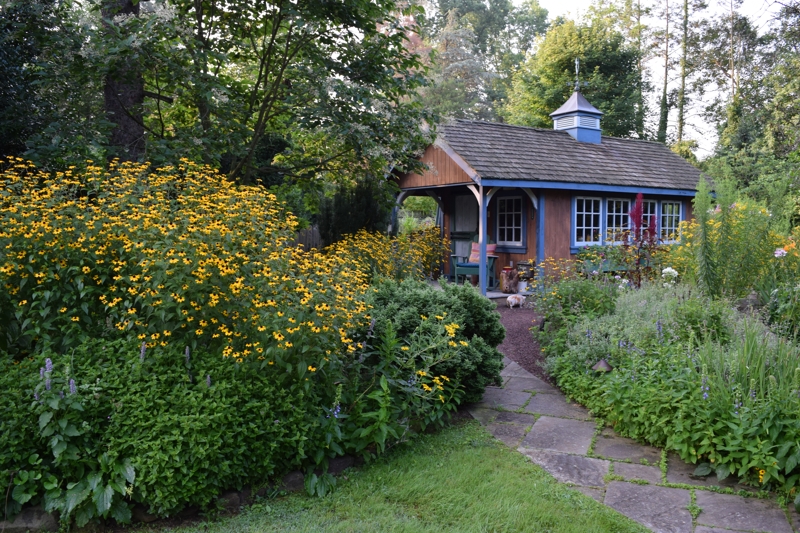
If you haven’t bought a wall calendar for next year—and no one bought one for you for a holiday present—check out the She Shed website. I am the August page of the She Shed Living calendar. This is the shed that we call Rose Cottage. There are roses growing beside it. It is the hub of our operations and contains the tools and pots that we need to run the garden. It is also a place of retreat. There are a couple of comfortable chairs. When you sit on the chairs you can see over the small pond, and into the herb garden. I find it an inspirational place to sit when I need to re-charge the writing part of my brain.
I get nothing from this, but it is sort of fun to see what other people do with their sheds.
Speaking Engagements
I will be speaking at Wing Haven January 19th, 2023. Wing Haven foundation is combined with the nearby Elizabeth Lawrence’s Garden in Charlotte. Check out their website for more information. Come and see me if you are nearby or there is an online zoom option too.
January 30th, 2023, I will be lecturing for the Gardeners of Rose Valley, Pennsylvania, at 7:00 pm. It is a community lecture open to the public.
February 4th I will be at The Frelinghuysen Arboretum in Morristown, New Jersey, for a public lecture at 1:00 pm.
In mid-February I will be lecturing in Ann Arbor and Grosse Point Michigan
On February 18th and 19th, 2023 I will be speaking at the Northwest Flower and Garden Show in Seattle. I will be lecturing on two different topics to do with growing flowers, tying in with my new book, The Ultimate Flower Gardener’s Guide. I will also be taking part in the crowd-pleasing Container Wars.
Blog: Winter Sowing

As the days lengthen in the Northern hemisphere, it is time to start thinking of growing plants from seed. The blog this month explains an easy method to start hardy seeds outside in winter. It is so simple you will be able to do this with your children and grandchildren. Just don’t give them the sharp knife—you will see what I mean as we go through the instructions.
January Star: Sarcococca
I have made it a special mission to include plants in my garden that bloom throughout the winter. This is to give the pollinators some flowers every day of the year, but also to improve my frame of mind. I am not a winter person, so I love having some flowers to go and visit even on the coldest days.
At this time of year, I am grateful for splashes of vibrant, evergreen color that help lift up the general tones of taupe and beige. Enter the vibrant strap-like leaves of the variegated yucca. I admit that I wasn’t always a yucca lover—in actual fact I was a yucca hater—the leader of the “yucky-yucca club.” What turned me around was the easy care (almost no care) and its role in the garden as a butterfly- and hummingbird-attracting flower.
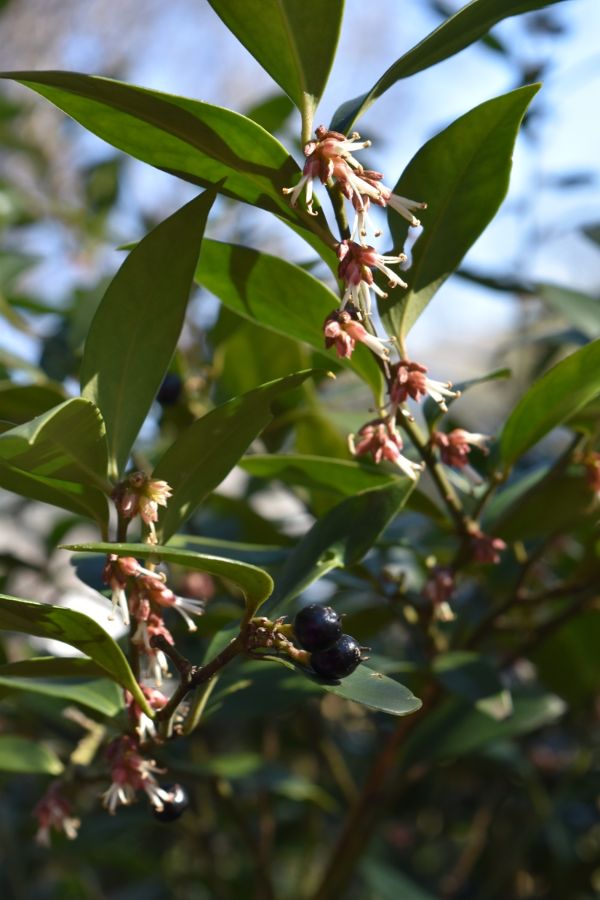
The winter-blooming plant that I have chosen for you this month is one that begins blooming in December and carries on through January. Sarcococca orientalis (Christmas box or sweet box) has small flowers, but they are fabulously fragrant, even from a distance. The flowers are followed by small, glossy, round, black fruit that persist until the following autumn. It is an evergreen shrub with broad glossy leaves. Stems of sweet box are good for winter arrangements paired with holly and needled evergreens.
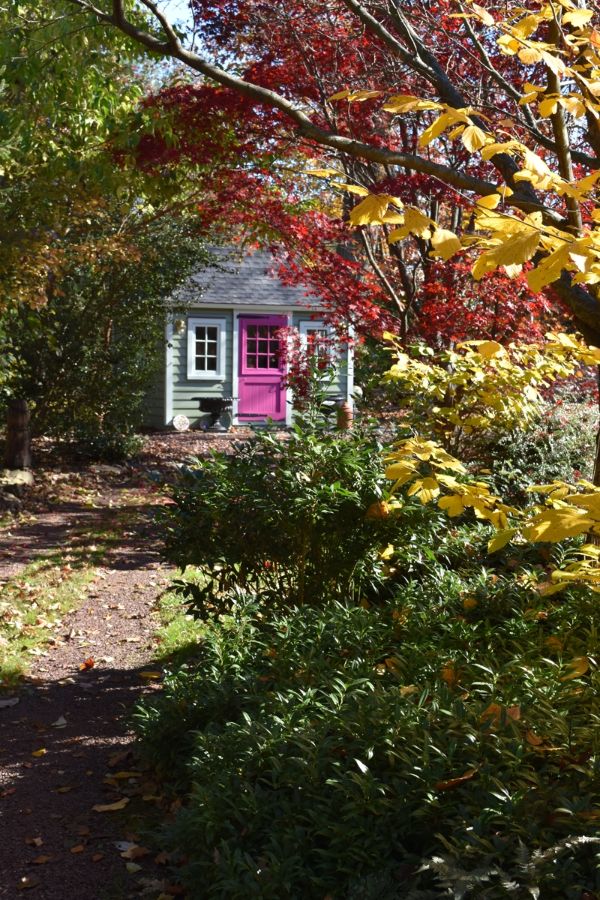
Sweet box is an easy-care plant that is native to Asia. It is thought to be hardy from Zones 6b to 8 or 9. It has been in my garden for at least ten years and has come through some bad winters unscathed. It grows to about three feet tall and the original plant is about two feet wide.
Plant it in a shady area with some moisture in the soil. I have it planted along a raised bank where the soil is fairly well-drained. It benefits from some organic matter added to the soil to improve it. Where it is happy it may spread outwards from the original clump by suckering. It can be propagated from cuttings or by seed.

The genus Sarcococca includes several garden-worthy plants, including the more well-known, lower-growing Sarcococca hookeriana var. humilis, which blooms in January and February. It only reaches one and a half to two feet tall and forms suckers to make a great groundcover. This plant is hardier than sweet box.
Book Club: Beautiful at All Seasons

Elizabeth was known to be an experimental gardener and was a cheerleader for gardening in the southern part of the United States. At the time that she was writing, much of the garden literature was based in the Mid-Atlantic states or New England. Elizabeth wrote from experience and correspondence. She wrote to people who she felt would be able to help her understand how to grow plants better or where you could buy them.
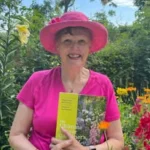
This book is a compilation of Elizabeth’s writings compiled and edited by Ann L. Armstrong, who is a garden writer in Charlotte, and Lindie Wilson, who bought Elizabeth’s house not knowing what she was acquiring. I was lucky enough to meet Lindie at a lunch a few years ago. What a great privilege to be able to talk with someone who took on the project of keeping Elizabeth’s legacy and story alive.
The two editors pull together some wonderful pieces of Elizabeth’s garden writing on a wide variety of subjects. Apart from the quote at the top, I am really entranced by their coverage of the history of gardening. There are so many great articles that I am sure you will find some little gem that relates to you and your garden.
I love growing sweet peas, so it was a delight to see Elizabeth’s writing about Father Cupani, an Italian monk and botanist who grew sweet peas in 1701 (page 43), and then Jane Loudon, an English garden writer, who describes a pink and white cultivar called ‘Painted Lady’. I have grown both ‘Cupani’ and ‘Painted Lady’ sweet peas in my garden. They are both intensely fragrant, unlike some of the newer varieties. I would recommend this as a wonderful winter read.
Note: I am not sponsored to promote books found in these newsletters. They are featured because I truly love them.
If you like this newsletter, please tell your gardening friends about it. It is easy to subscribe by contacting me via my website.
If you would like to see photos of my garden at Northview and images of my garden travels, please follow me on Instagram @NorthviewGarden and @JennyRoseCarey
Bye for now,



Leave a Reply