
In the News: Garden Tours
and Online Lectures
I love this February quote from Henry Mitchell about taking time to enjoy your garden rather than thinking of all the things that you should be doing in it. I am not sure what type of pest he is thinking that we become if we are not contemplating beauty in our gardens?

If you want to see pictures of Northview, click here!
Online Seminars
If you like online educational programs, there are a couple of opportunities in the next month where I will be participating. Registration is at the links below. Please join me.
February 22nd, 2024, at 6:00 p.m. EST, hosted by Garden Design magazine, I will be giving a talk about shade gardening called “Shade Gardens: Winning Plant Combinations and Design Ideas.” Sign up soon because registration closes when “seats” are full on the Zoom call.
March 7th, 2024, at 7:00 p.m. EST I will be taking part in the National Garden Bureau and Garden Communicators Book Party. I will talk about my latest book for Timber Press, The Ultimate Flower Gardener’s Guide. There will be four authors who will answer questions, a breakout session where you choose one author and can ask them questions, and lots of fun. The other authors are Lorraine Johnson, Nicole Johnson, and Jeff Rugg. Watch my Instagram for more details closer to the date. Registration is open at the National Garden Bureau website.
Here are some YouTube recordings of past Book Parties so that you can get an idea of what it entails and see some other great authors.
March 8th, 2024 at 12:00 p.m. EST and 4:00 pm EST. I will be speaking at the Philadelphia Flower Show at the Pennsylvania Convention Center. At noon, I will be talking about my book Growing the Ulimate Flower Garden. Later in the day at four, in the PHS Member’s Lounge I will be discussing garden design ideas for your garden.
From Seeds to Flowers

Have you ever wished you could grow flowers from seed? How about poppies and larkspur? I have been growing flower and vegetables from seed all my life. There is no real mystery to the process.
Tips for Seed Starting Indoors

- Wait to sow seeds until it is the correct number of weeks before the last frost that it says on the back of the seed packet. Most enthusiastic gardeners start seeds too soon and then they become straggly before you can plant them outside.
- Use seed starting mix—peat-free if you can find it.
- Follow the directions on the packet whether to cover the seeds or firm them into the surface. If you like, you can add grit to the soil surface to keep the top of the soil moist—but not wet—in order to trap the seeds.
- Some seeds will germinate better with bottom heat from a heat mat. Another option is to place the seedlings on a shelf above a radiator.
- Keep soil moist but not wet. Water from the bottom not the top by putting water in the bottom of the underneath tray and removing water after an hour or so.
- Give the seedlings lots of light once they poke through the soil. The grow lights should be right down over the top of the leaves. A sunny windowsill is the second choice.
- Provide plenty of air circulation. Take off the clear cover once the seedlings emerge if you have used one to help with germination.
Jenny Rose Carey on the Road
I was lucky enough to be able to take a trip to North and South Carolina earlier this year. Of course, I managed to see a few gardens. In Wilmington, North Carolina, I went to the NC State Arboretum gardens in New Hanover County. It was camellia time, and I was really taken with the variety of shapes, colors, and fragrances.
Next, I went to nearby Airlie Gardens with its magnificent old live oak trees dripping with Spanish moss. There is one oak in particular that is hundreds of years old and is the centerpiece of a large lawn. I loved the bottle chapel that was created using thousands of bottles to honor the artist Minnie Evans, who was a longtime gatekeeper at the gardens.
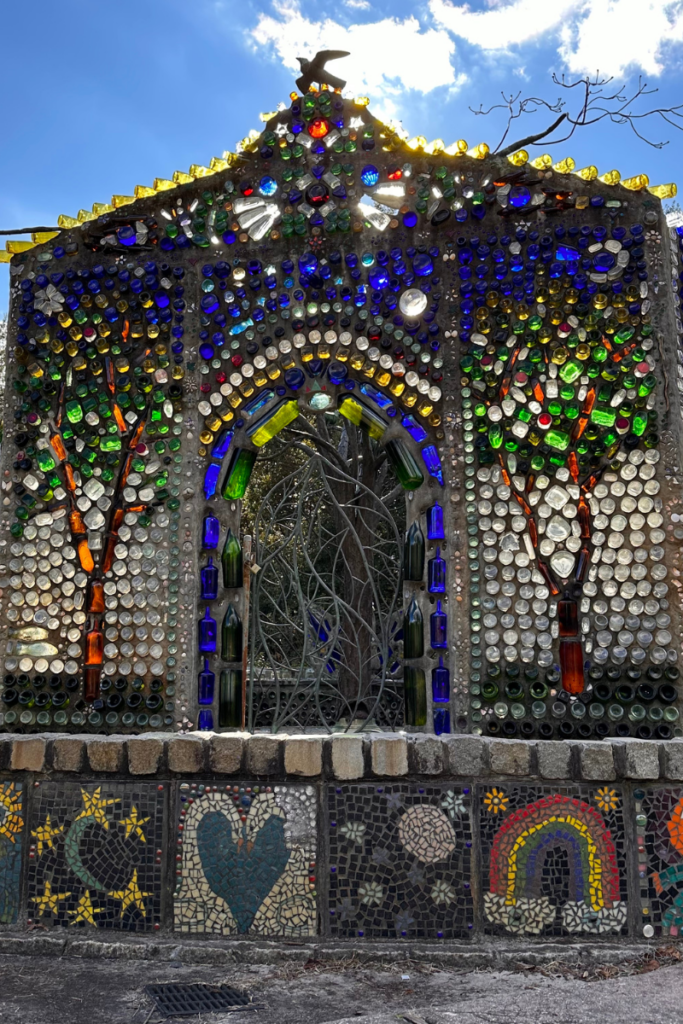
In South Carolina I went to Brookgreen Gardens, which is a huge sculpture garden. There are a series of garden rooms and paths that link them. Fountains feature prominently. It is a garden for exploration and contemplation. There is a lot to see and it is an extensive garden, so leave yourself plenty of time to visit. I enjoyed my walk around, but my favorite part was finding a quiet bench in the sunshine and listening to the birds and the splashing water.
Plant of the Month: Hamamelis ‘Rochester’
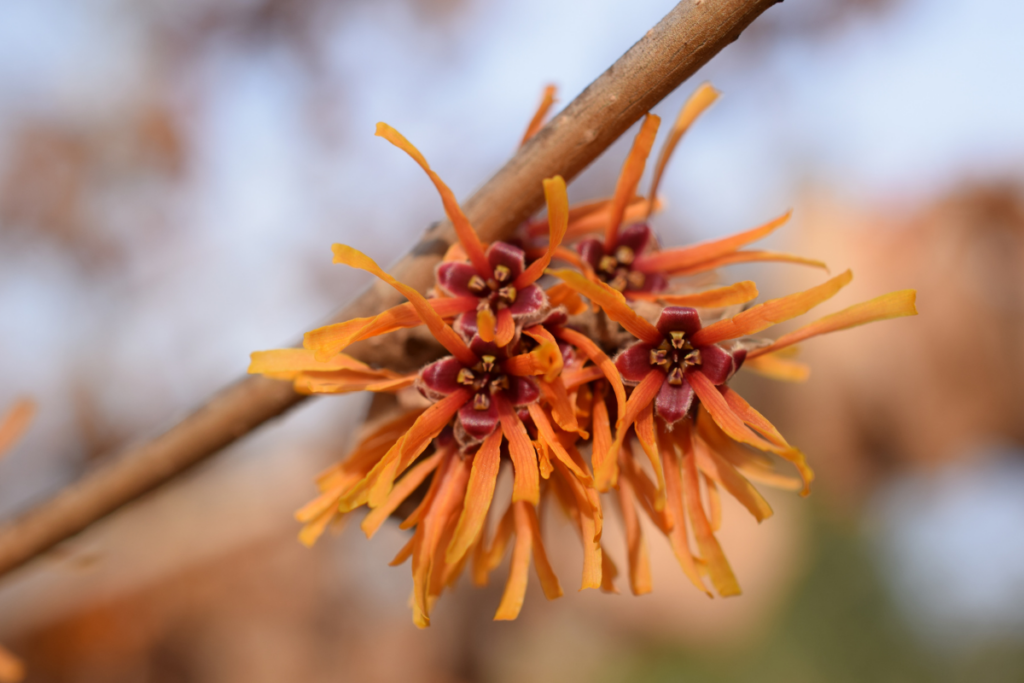
I have an obsession with witch hazels, especially the fragrant ones. I have at least one witch hazel in bloom from fall to spring. Their flowers are rather strange and insect-like in shape. There is a central part called the calyx that can be a different color to the elongated narrow petals. The strappy petals curl up in the cold and extend in warm sunny weather.

I have amassed a collection of 45 species and cultivars. There are some species that are native to North America, and others that come from Asia. Most of them are the result of crosses between different witch hazels. The only ones I buy are scented because there is nothing better than walking down my winter walk and being hit with a nose full of perfume in the still winter air.
This month I feature one of the early-blooming ones that is a favorite. The cultivar is called ‘Rochester’. The maroon calyx is surrounded by burnt butterscotch-colored petals.
The fragrance is warm and a mix of fruit and spice. As we know, scent is hard to explain so if you can, get out to a public garden that has some witch hazels and smell them for yourself. Or better still, see if you have room for a witch hazel or two in your garden.
Book of the Month:
One Man’s Garden, Henry Mitchell, 1992, Houghton Mifflin Company.

Henry Mitchell was a garden writer for the Washington Post. His dry wit and perceptive observational skills gave his writing relevance and humor. This book is arranged by month, which I like because you can dip into it to find something relevant to the gardening season and maybe finish that part before falling asleep—not because it is in any way boring, but last thing at night I cannot keep my eyes open to read. There are many lovely quotes and passages that I read and re-read. I am sure that you will hear more in this newsletter later.
The part of the February chapter that I am going to dwell on is Henry Mitchell’s discussion of time. Time in February is worth discussing. There are only 28 days (or 29 in this leap year) and despite its few days, it seems to drag on forever.
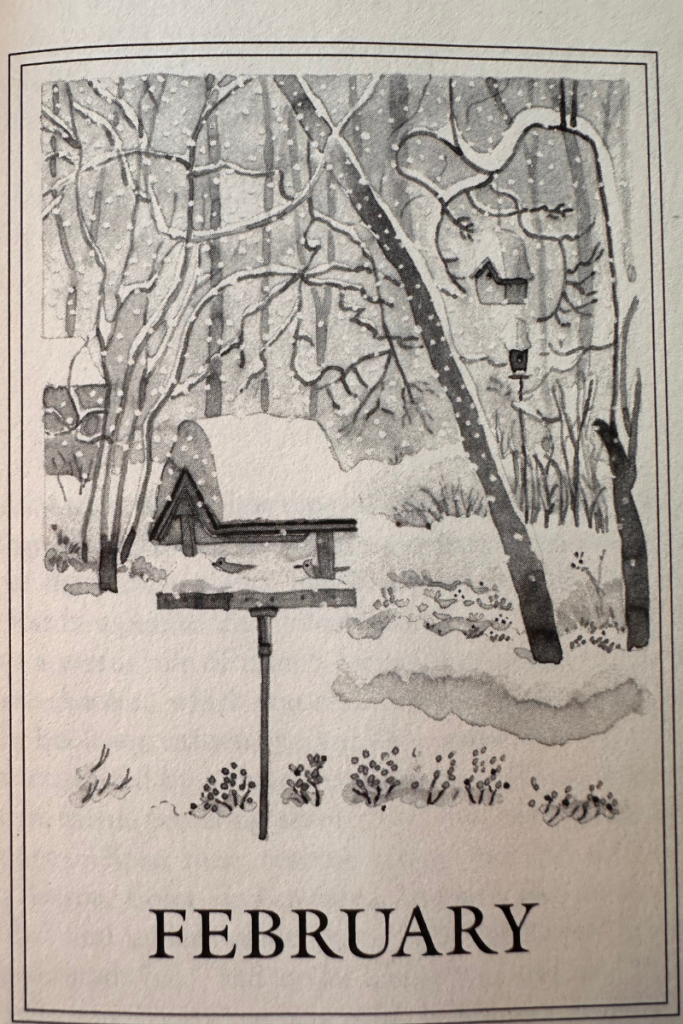
He begins this essay by stating, “When you first start to garden, you usually have no idea what the real delights are going to be.” He continues, “The comings and goings of flowers, the rise and fall of plants, are of utmost importance in the pleasure of gardening, far more than the young gardener might think.” Henry explains it this way: “In the garden, at least, you soon grow almost sick of flowers that bloom endlessly … they are nice enough; it’s just that after a few months you wish that they would look different.” I quite agree and it is one of my arguments against flowers like orchids that look the same for weeks if not months.
My big take-home message from this lovely piece of writing is to really enjoy this lull before the storm of flowers. We appreciate the blooms of spring because they were not there in February. I will try to take that to heart even though there are 29 whole days to be patient. Then maybe spring will come.
By the way, in this author photo from the dust jacket of the book, Henry Mitchell the garden writer in his trench coat looks more like Henry Mitchell the pretend spy in a great novel. After all, he did live in Washington, D.C.
In Case You Were Gardening…
Towers to Flowers – January 7, 2024
Snowdrops and Galanthomania – January 28. 2023
Top 10 Favorite Garden Witch Hazels for Spring Bloom and Fragrance – March 30, 2015
If you like this newsletter, please tell your gardening friends about it. It is easy to subscribe by contacting me via my website.
If you would like to see photos of my garden at Northview and images of my garden travels, please follow me on Instagram @NorthviewGarden and @JennyRoseCarey
Bye for now,




Leave a Reply