
Fences and Hedges—Permeable Barriers
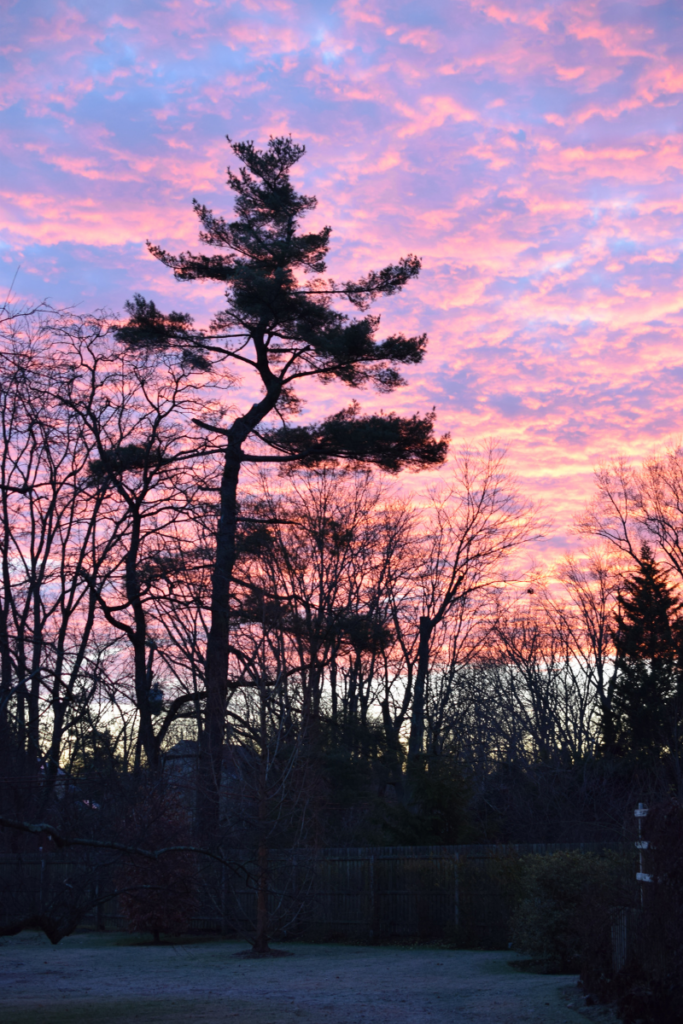
The end of the year is rolling around and with it comes thoughts of gardening highs and lows of the past year. I love the way that Canon Ellacombe expresses his thoughts about the garden in December in the quote above. He was the vicar of a small parish in west-central England. There were many gardening vicars who also wrote about their gardens, but Canon Ellacombe’s garden had a great reputation, being visited by the gardening greats like Ellen Willmott. (There is more about the Canon Ellacombe in the book review below.)
For most of us, December is a busy social month so maybe we don’t get time to bemoan the lack of flowers in our gardens. However, there is still plenty of garden thinking that needs to be done now if you can get yourself outside to look.
December is for planning on a large and small scale. Once the deciduous leaves are off the trees, look at new views or sightlines that have opened up to reveal hidden objects. These borrowed views are an important part of gardening. (The Japanese language even has a word for borrowed scenery—shakkei. How lovely!)
You may be able to see a shapely or distinctive tree down the street that catches your eye. I have a sightline to an old cedar tree two houses away that is not visible in the summer but shows up nicely now. Look at eyesores as well as good things. If you don’t like the look of something, you may need to add an evergreen tree or shrub. If you like what you see, make sure that future plantings don’t block it. Evergreen plants are the best things to disguise bad views, but a fence or hedge might also work.
This broader thinking of your garden as a small part in a larger network of green spaces is an important mindset change. Instead of imagining our fences or hedges as boundaries, think of them as corridors and doors from one garden to the next. Animals that travel or migrate do not know where your garden starts and ends. They need access to get through, under, or over, as seen by the current popularity in England of hedgehog holes through fences to enable these cute, iconic, but now declining species to roam through backyards in search of food.
This winter, think about your boundaries. Certainly hedges—the more diverse the better—are a hiding place for overwintering insects, nesting birds, and hibernating mammals. Do have fences, but maybe make them permeable in places. However, if you want to grow cabbages, parsley, or marigolds, do have bunny-proof areas to keep out the rabbits!
In Case You Were Gardening…
These are some of my favorite seasonally relevelant blog posts from over the years. You can also read previous newsletters here!
Winter Seed Sowing in Old Milk Jugs
Inspirational Women in Horticulture
Garden Travels
I had a lovely trip to Louisiana to give a couple of lectures for the Southern Garden Symposium in St. Francisville, near Baton Rouge. I have been there before, but a long time ago. I received a very warm southern welcome, had some fabulous food—shrimp and grits is a favorite dish—and saw some great gardens. A big thank you to all of the organizers and my hosts and hostesses. I had a thoroughly wonderful time.


December Blog Post

Book Roundup – Some Books Old and New
That I Recommend for Winter Reading
Another year has passed, and many books have been read here at Northview. Despite my family members occasionally muttering, ‘do you think that you have enough gardening books now?’, I continue to buy, collect (some might say hoard), and read gardening books.
Plants of the month – Evergreen Hollies:
American Holly – (Ilex opaca) and
English Holly (Ilex aquifolium)
There is something about the contrasting red and green of holly berries and leaves that makes me happy. The trees are laden with berries this year and the old wives’ tale is that lots of holly berries on the tree is a sign that it will be a hard winter. For a start I am not sure that it is a politically correct thing to say that only wives were saying this, but maybe they were wise women—who knows? And as a point of interest, hollies come in male or female plants and the females are the ones that have berries.
I hope that you will consider planting a holly or two, especially if you are looking for a broadleaved evergreen that will take part shade, but needs good moist, well-drained soil. Holly of all types is great as a boundary plant that can be used to block unsightly views (as discussed in the introductory part of this email), and the berries that are borne on the female plants are a fantastic feast for songbirds. American robins come in a flock and denude my large American holly.
To get the best fruit set, you will need to plant both female and male plants. Usually there are other trees in the neighborhood that will pollinate your trees. If you are planting both types, tuck the male behind the females as it is less interesting. You will only need one male plant even if you are planting six or seven female hollies.
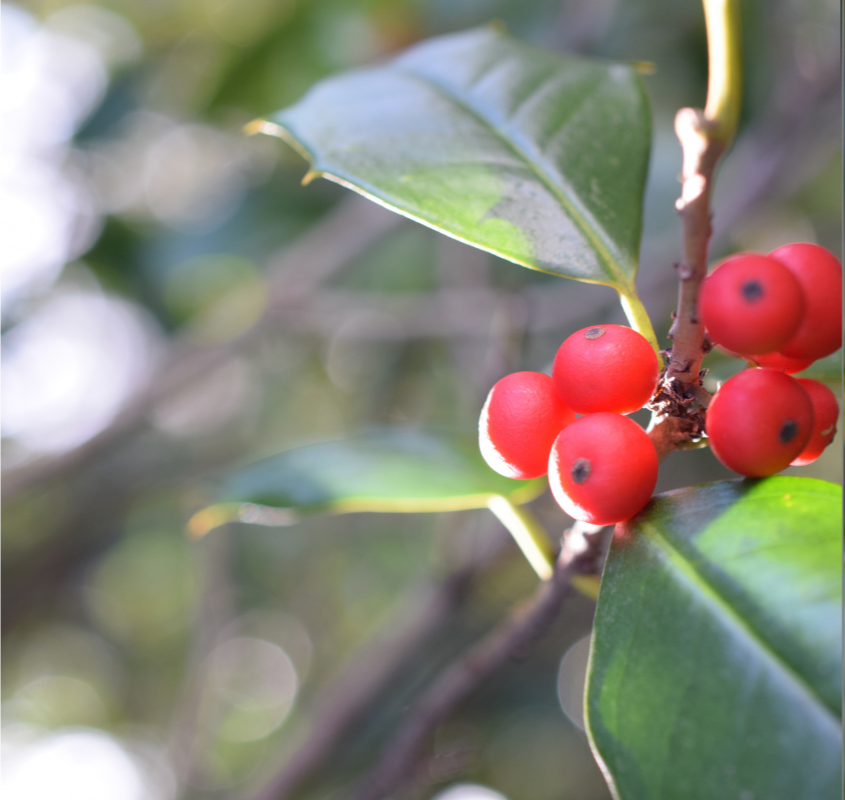
When I moved to Northview there was a huge American holly (Ilex opaca) that stood in solitary splendor in the lawn. Even in 1997 it looked old, and now twenty-six years later it is still growing strong. I have cut bags and bags of holly branches off this tree to donate for holiday decorating and every year the tree seems bigger and stronger.
The leaves of American holly are matte and larger than the English holly (Ilex aquifolium) that I grew up with. The English holly is less hardy than the American holly. When I first moved here, I was told that I would not be able to grow it. To test this out, I purchased some small variegated English hollies and planted them in a tucked-away position, out of the blasting westerly wind that roars down my driveway, especially in winter. To my delight they have survived and grown slowly over many years. A few of them got eaten early in their lives by deer and have never caught up, but I like them nonetheless.

If you are really interested in learning more about holly, there is a wonderful group called the Holly Society of America. They provide information and will answer questions.
Book of the Month:
In a Gloucestershire Garden by Canon Ellacombe (Edward Arnold, 1895; in reprint with introduction by Rosemary Verey, National Trust Classics, 1982).
What a delight to dip into the December writings of Canon Ellacombe, vicar and gardener. This book is a compilation of a series of articles for an English newspaper called The Guardian from 1890 to 1893. The first half of the book has one essay per month. The writings are old and occasionally dated but what I love is that his character, wisdom, and love of literature come through in his comments. I can relate to them through the centuries and find nuggets of insight.

The December chapter begins with this quote: “What can one say of the garden in December? Can anyone honestly say that the garden in December is pleasant, or give pleasant thoughts? The general verdict of December would be given in Tennyson’s words:
‘Earthward he boweth the heavy stalks
Of the mouldering flowers
Heavily hangs the broad sunflower’’’

He then goes on to pontificate on what to do about those “heavy stalks.” Ellacombe states, “I never think that the prospect of the garden in December is much better by making all the flower-beds too tidy. I feel sure that the dead flower-stems (the ‘Kecksies’ of Shakespeare and the old writers, and the old word still lingers in a few parts) must be some protection to the plants … When the hoar-frosts come, these dead stems, especially where the dead flower-heads remain, put on a wonderful beauty.”
How true! I love seeing the flower heads outlined with frost or catching a bit of snow. And as he points out, the folded stems laying over the crown provide winter protection against the cold. Later he says, “I am not fond of frost and snow, and the older we get, the less we like it. But I have no doubt whatever that frost and snow have their uses, and that we should be all the worse without them.”
Out of interest I looked up “Kecksies” and Wiktionary came up with: “The hollow stalk of an umbelliferous plant, such as hemlock.” If my English brother-in-law is reading this, I am sure he will tell me that this quote is really about underpants. (“Keks” is a British slang term.).
“His favourite doctrine was that a true gardener
is known by the pleasure he takes in giving plants to
his friends. And certainly, judged by this standard,
he was a prince among gardeners.”
– A Memoir by A.W. Hill, page 137
Benedicite [BEN] + [I] + [DY] + [SUH] + [TEE]
– Grace Go with You
Since the Canon was a man of the cloth, I was expecting to find some reference to his daytime job of being the vicar of a small parish in Gloucestershire called Bitton.
On pages 94-95 of the reprinted version, or page 140 of the original he says, “During Advent we always use the Benedicite in our Advent services; and as I read it in December I am forcibly struck with the way in which the writer speaks of winter. While in almost every other ‘work of the Lord’ he gives but one verse or less of his grand hymn, to winter he gives no less than four—”O ye winter and summer,’ ‘O ye dews and frosts,’ ‘O ye frost and cold,’ ‘O ye ice and snow,’ ‘Benedicite Domino, laudate et superexaltate Eum in saecula.“ (Grace go with you, Praise the Lord, Bless and exult him above all forever).
(NOTE to my family and friends – if you see me wandering the frosty garden murmuring ‘O ye ice and snow,’ you will understand).

There is much more to say about the gardening Canon, but I will leave it there for now. I will dig and delve into some other months and share some further thoughts with you in a future email.
My next missive will wing your way in the new year of 2024! If you have enjoyed this email, please pass the word to your gardening friends to subscribe via my website jennyrosecarey.com. Thank you.
Note: I am not sponsored to promote books found in these newsletters. They are featured because I truly love them.

If you like this newsletter, please tell your gardening friends about it. It is easy to subscribe by contacting me via my website.
If you would like to see photos of my garden at Northview and images of my garden travels, please follow me on Instagram @NorthviewGarden and @JennyRoseCarey
Wishing you, your family, and friends, the happiest of holidays. Goodbye for now, gardening friends!



Leave a Reply