
The Carefree East Lambrook Manor
These words, penned by garden writer Margery Fish, were written in 1966. What has happened to gardening in the intervening time period? Are we still chasing the same idea of “striving for a natural effect”? I think that these same words could easily be written today, just as they were nearly sixty years ago.
Margery gardened at her cottage in East Lambrook, Somerset, England. She was a proponent of the cottage garden style, and was one of the people who was responsible for a 20th century resurgence of interest in this type of gardening. Margery was known for her observational ability. She could spot a good plant, beg a piece from a friend, and then publicize it in her writing. She was a hub for plant dissemination and promotion.
So, what did Margery mean when she talked about carefree gardens? As Margery pointed out: “We all know the parts of our gardens that take care of themselves. They are the corners that give us no trouble for they always look nice, and go on for months on end without receiving attention of any kind.”

I had the chance to visit her garden some years ago. What I loved about the gardens when I visited there was they had the relaxed feel I admire. The garden was not too pristine but had an air of being lived in. You felt like you could walk along the paths and not fret or worry if you brushed against the overhanging plants. A cat was strolling along the paths ahead of us, leading the way. It was a comfortable garden that welcomed you in.
I am sure that not much of her garden then, or today, was truly “carefree” or low maintenance as we might call it now. But, to me, if you look back at the quote at the top of the page, there is a clue there. If we garden in a way that has “a natural effect,” there is a good chance that your garden will be somewhat “carefree.” Planting hardy plants that live with their neighbors in groupings, where they all require the same growing conditions, is a big first step. Looking for plants that grow in your area naturally is another. Finding plants that grow without extra watering, fertilizing, or fussing is also part of this plan.
The other aspect is thinking about your gardening aesthetic. I have had many garden tours here at Northview this year. One of the big realizations I have been having is that I am very happy with my garden being loose in style. This means that the leaves stay, rot in place, and eventually enrich the soil. It also means that many plants seed themselves into the garden and grow where they land. It is a vaguely edited arrangement that suits me. I know it has its roots in my English cottage garden heritage. I also know that it is time that we who garden in America need to start embracing this style. It takes fewer interventions and resources. It is a stress-free approach where my well-worn pandemic expression comes in to play daily: “Oh well.” Try it and see if your garden can become a little more carefree too.
Northview Dry Garden
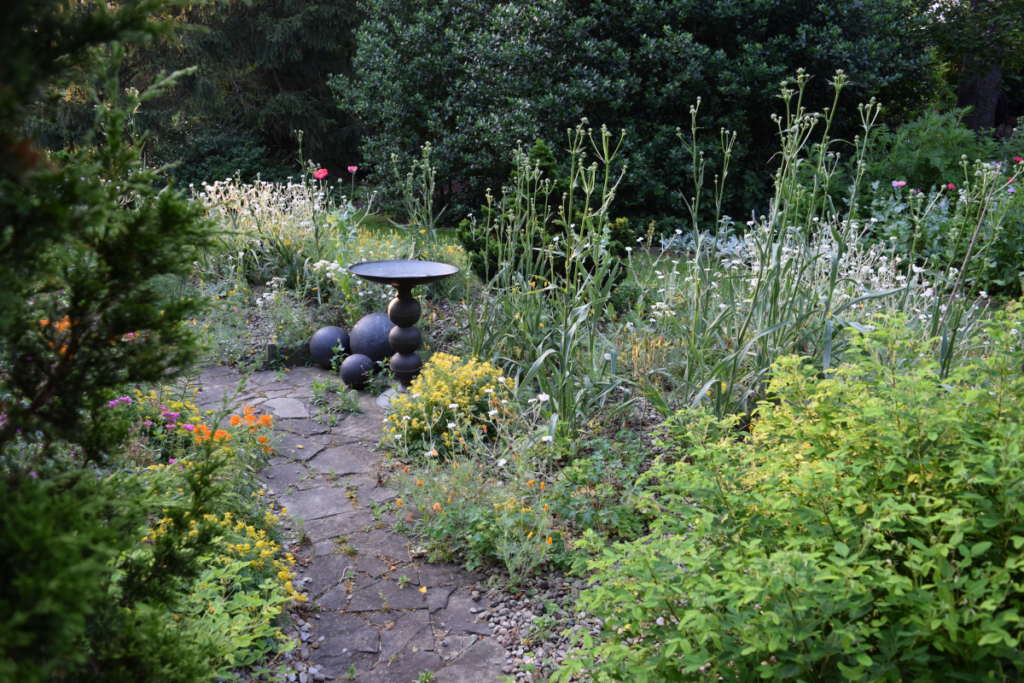
In this month’s blog I will be sharing some thoughts about my Dry Garden here at Northview. I installed it 20 years ago and the only water that it has received is from natural rain and snow. You will be amazed at how well plants do if chosen carefully, planted sensibly, and then ignored.
Plant of the Month:
Stokesia laevis, Stoke’s Aster
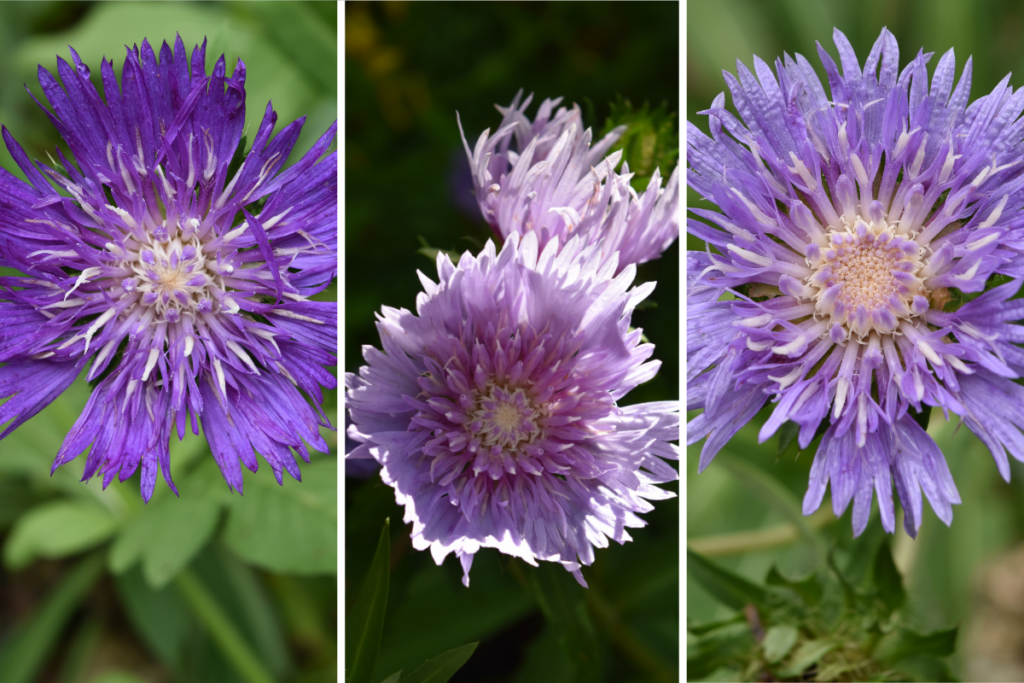
The plant of the month is Stoke’s Aster, or Stokesia laevis. It is one Margery liked for its carefree nature, and it is still not grown as much as I think it deserves to be. She praised the foliage quality and the large flowers. I would agree. This plant is not an aster but, maybe to some people, it has a similar shaped flower. It is much larger in size with blooms several inches across. The plant is a foot or more tall.
The colors of Stoke’s Aster flowers range from white, through lovely periwinkle blue, to a dark purple. They bloom over the course of a few weeks, with new flowers forming on side branches after the initial flush of blooms. Cut off the first flowers after they finish to encourage a long blooming time. You can save the seed or sprinkle it in your garden to get new plants. The leaves are elongated and slightly glossy. In mild winters, they are evergreen; in harsh winter climates, they will be semi-evergreen.
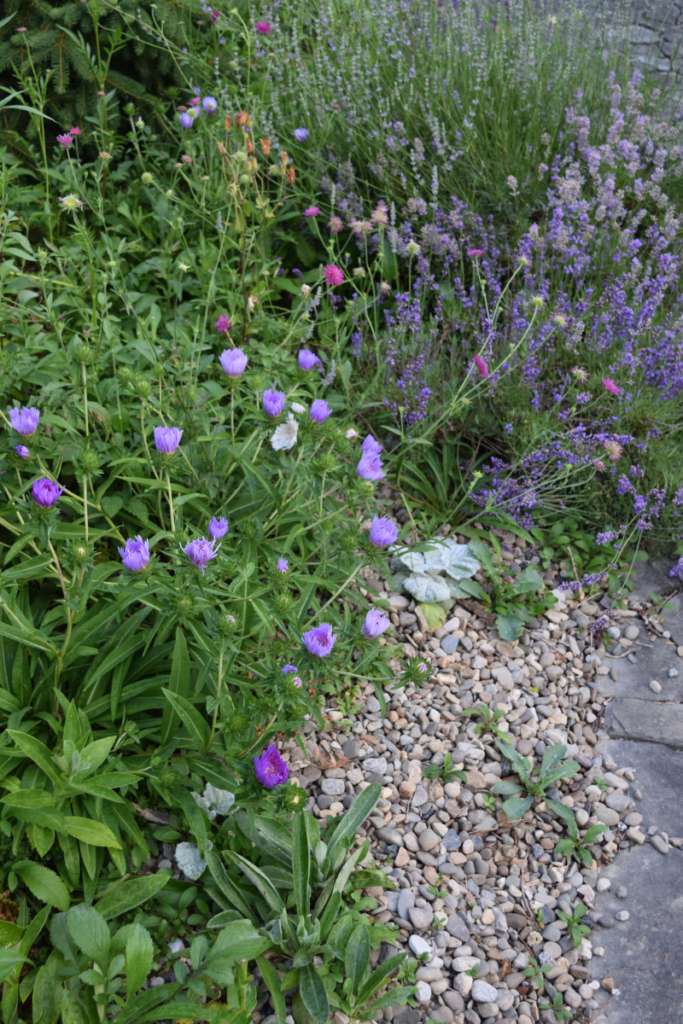
Stokesia is native to the southeastern United States where it seems to grow naturally in moist areas. However, in my garden, our most successful patches are growing in the Dry Garden (see blog post link above). They have seeded themselves into the gravel and do really well, despite never being watered. I would highly recommend Stoke’s Aster for the perimeter of a rain garden, where there is alternating wet and dry soil.
Use Stokesia as great cut flowers and wonderful pollinator attractants. They are adaptable to sunny conditions or part shade. Their excellent qualities also include resistance to both rabbit and deer browsing. They are hardy in USDA Zones 5 to 9.
Look for cultivars such as ‘Color Wheel’, which changes color as the flower ages; ‘Honeysong Purple’ with vibrant purply flowers; or ‘Peachie’s Pick’, which is a good all-round plant. There is a cream cultivar called ‘Mary Gregory’. Grow Stokesia with other drought-tolerant plants like lavender, Knautia macedonica, sedums, poppies, and low-growing campanulas.
Book of the Month:
Carefree Gardening by Margery Fish
This slim paperback could have gone unnoticed on my bookshelf, but I was thinking about this author the other day, so I picked it up and got drawn into reading it. Margery’s writing style was encouraging, and plant-packed. She gave fellow gardeners ideas of plants that she liked, and clues about how to grow them well. This book is right in tune with the desire of current gardeners for a low-maintenance garden.
If you are interested in reading about Margery’s other books and her garden, you can find it here.

One of the other quotes from the book that I love is: “When plants are allowed to grow naturally they make a harmonious picture and the result is a happy garden, and a happy garden is a peaceful one, with a backbone of plants that go on from year to year.” (I have to say—that is only one sentence. My editor would be so mad if my sentences were that long.). She continues: “A good garden can be made with plants that do not require constant attention.”
What Margery was suggesting all those years ago is if you plant in an informal style and plant things that are well-suited to your garden conditions, then you have to do less active gardening. The book has many specific plants that are mentioned—including Stoke’s Aster, which I have picked as the plant of the month. I love reading her plant descriptions because she was very accurate. However, for this book, the most important part for me is her hassle-free gardening ethos. It is a way of gardening that I want to capture and use in my own garden.
East Lambrook Manor has gone through several owners since Margery’s death in 1969. The property was recently sold, and it is not clear what the new owners will do. I hope that the gardens continue to be open to the public.
Here are a few links that I think are worth checking out about Margery and East Lambrook Manor:
East Lambrook Manor’s Website
Margery Fish biography from Great British Gardens

Note: I am not sponsored to promote books found in these newsletters. They are featured because I truly love them.
In Case You Were Gardening…
“Munstead Wood – Gretrude Jekyll’s Garden” — July 15, 2024
“Self-Sown Flowers – Create Bargain Fullness and Happy Accidents” — September 17, 2022
“The Scoop on Summer Staking” — August 16, 2023

If you like this newsletter, please tell your gardening friends about it. It is easy to subscribe by contacting me via my website.
If you would like to see photos of my garden at Northview and images of my garden travels, please follow me on Instagram @NorthviewGarden and @JennyRoseCarey
Bye for now,



Leave a Reply