
Resolve to Garden
These prescient words were written by the well-revered 20th Century British garden designer, Sylvia Crowe, in the 1950s in the wake of World War II. The world was “noisy“ then, but maybe not as noisy as it is now. These words remind us that gardens have many functions. We often think of the garden for food and flower production, but this quote reminds us of other garden roles: as a refuge, as a place for creativity, and as a place for being with nature.
If any of the sentiments expressed by Sylvia Crowe resonate with you, it is the perfect time to start your own garden. Maybe this year is the year to begin or improve your garden. Take this as your call to action.

But how to start? I always suggest starting small (not that I ever listen to my own advice). Find the site first. Choose a sunny spot if you want to grow vegetables like tomatoes, or annual flowers like zinnias.. If you are really looking for a peaceful place to sit, then a shady spot–just slightly away from the trees, may be the best choice.
Next, begin a plant list for the conditions you have. Work out the amount of light that falls on the garden area: sun, part-sun/part-shade, or mostly shade. Then choose plants to suit this area. The plant list can be organized by season if you want things to grow all year, or just choose summer plants if the garden is next to your warm-season sitting area.
The third part of the process is to get the soil correct, so your chosen plants grow well. Observe the potential garden area to see whether the soil puddles after rain, or if it dries out in the summer. These are the extremes of soil moisture, but most plants need soil that is somewhere in between. This is often described on plant tags as moist, well-drained soil. To many gardeners, this can seem like an unsolvable conundrum. How can it be moist, and at the same time, well-drained? Your goal is to create soil that is like a wrung-out sponge. It contains water, but is not soaking wet.
Here at Northview, we have a clay-loam soil that holds on to moisture. The way that we achieve moist, well-drained soil is to raise the beds above grade level, and then amend the soil with two main components. We add these components into the planting hole, and also use them as a top dressing, or mulch, on the soil surface.
- Organic materials like leaf mold, or compost (to help retain moisture).
- Grit and/or gravel, (to improve drainage).
If your soil is sandy or stony, you may not need the grit, but you will need lots of organic matter. (See the blog post below to learn more about using chicken grit in flower beds and containers!)
Before You Garden…
This month, I discuss the use of chicken grit as a soil amendment in containers and flower beds. (P.S. This is not my chicken)
Moist, well-drained soil is especially important for growing bulbs – particularly when grown in containers. You can read more about this in my book, The Essential Guide to Bulbs, page 268, under the sub-heading “No Soggy Bottom”.

Curious About My Garden?
Throughout the spring and summer of 2026, I will be hosting three Open Garden days from 10am to noon at Northview, the four-and-half acres I call home. Full of intricately connected small gardens, whimsical fountains, native shade plants, and much more, a visit is sure to leave you with inspirations for your own gardens.

The entry fee to Open Garden Days is $20 per person. Parking is limited, so I advise carpooling if possible. Pink or flowery outfits are encouraged, as well as floppy hats, garden-friendly shoes, and refillable water bottles. You can also bring a snack to enjoy in the garden. Painters and photographers are welcome. Children are free. Email me at jennyrosecarey@gmail.com to reserve your spot!
2026 Dates:
- September 26
- April 24
- June 5
Plant of the Month: Hyacinths

(See pages 84-87 – The Essential Guide to Bulbs for more information)
The scent of hyacinths on a warm spring day fills me with joy. Their fragrance is so difficult to describe to someone who has never smelled one before, but it seems to be universally admired. One of my favorite quotes about hyacinths dates back centuries. These often-repeated lines have numerous attributions, but the underlying idea is clear. Hyacinths, and other flowers, are necessary for our wellbeing, as much as the bread that we eat.
“If of thy mortal goods thou art bereft,
And of thy meager store
Two loaves alone to thee are left,
Sell one, and with the dole
Buy hyacinths to feed thy soul.”
The Gulistan of Saadi, 1270

When I was growing up in England, we had the choice of white, pale pink, or mid-blue hyacinths. We grew them in bowls and forced them into bloom for winter flowering inside. I still love them in the house in the cold months, but I also love them as part of my outdoor spring bulb display.
I interplant hyacinth bulbs with tulips or daffodils in the same large hole. When they emerge, they make a pretty picture, and from a practical point of view, they help support each other as they grow. I also plant hyacinths in my Herb Garden, where I grow the blue ones among my sage plants as an edging.
I was recently asked a question during a lecture about hyacinths that came back year after year, but the flowerheads had become smaller than the original size. I replied that I prefer them this way, because the flower heads mingle with surrounding flowers to produce a better effect in the garden than the original large-scale flowerheads. If you prefer the large heads, then re-plant them every year with fresh bulbs.

There are so many hyacinth colors to choose from now, but not as many as were grown in Victorian gardens. They loved hyacinths and grew many hues and shades that are not available in the garden trade today. One of the most amazing experiences of my life was visiting the bulb garden called Hortus Bulborum, outside Amsterdam, where these old hyacinths are preserved. It was magical to be in the spring sunshine, walking among the rows, immersed in fragrance.
In the States, the best place to buy old hyacinth bulbs is Old House Gardens.
Book of the Month:
Garden Design by Sylvia Crowe

Sylvia Crowe was a British landscape architect who, in this book, elaborates on her garden design ideas in a usable way. She shares her observations and preferences, and I would recommend it, especially if you would like to learn more about garden design and history. Sylvia’s writing is anchored in the mid-20th century, with its forward-looking designs that drew from different architectural traditions, including the Bauhaus movement. She begins with a brief history of landscape design, continues with design principles, suggested materials for gardens, and finally goes through various types of gardens.
One of my favorite lines from Sylvia is “Even without knowing why, we are aware of the immense peace of certain gardens, while others give us a sense of exhilaration, which draws one on to explore”. She is aware, as a landscape architect, of the ways to design a garden to evoke certain feelings. To me, these are the most meaningful gardens. They produce a visceral response.
I really enjoyed her description of Hidcote in Gloucestershire. She says, “Here no limit is placed on the variety of plants grown, but the flowering plants are used as furnishings for a series of open-air rooms and passages, enclosed by high hedges and trees.” It is no wonder that it is a favorite garden of mine, because that description echoes my ideal gardening ethos.
And finally, to tie back to the scented hyacinths above – Sylvia concentrates on the physical design of the garden, but she does not neglect fragrance. She states, “In old gardens the scent of plants was rightly counted as one of their chief beauties… to anyone living in a garden, and not merely looking at it, scent is still the most evocative attribute of a flower.”
| In Case You Were Gardening… |
| Seed Starting Time is Here – Spring will be Here Soon! / March 9, 2026 The Flowers That Bloom in the Spring / April 10, 2025 4 Easy to Grow Cutting Flowers from Seeds / March 5, 2025 |


If you like this newsletter, please tell your gardening friends about it. It is easy to subscribe by contacting me via my website.
If you would like to see photos of my garden at Northview and images of my garden travels, please follow me on Instagram @NorthviewGarden and @JennyRoseCarey
Bye for now,

Want More? Check Out My Books!
While shady areas can be a challenging area for gardeners, Glorious Shade shows you how to make the most of it by helping you chose the right plants for the space and sharing key designing and maintenance tips.
The Ultimate Flower Gardener’s Guide gives gardeners the confidence needed to create the flower-filled garden of their dreams. Instead of concentrating primarily on color, it brings flower shape and texture to the fore, helping homeowners to create cohesive, yet unique, flower gardens.
The Essential Guide to Bulbs is a gorgeously photographed, comprehensive, and inviting resource. While many gardeners may be familiar with the early show of spring bulbs, there are so many more to choose from that provide three-season color, drama, and spontaneity in the garden.
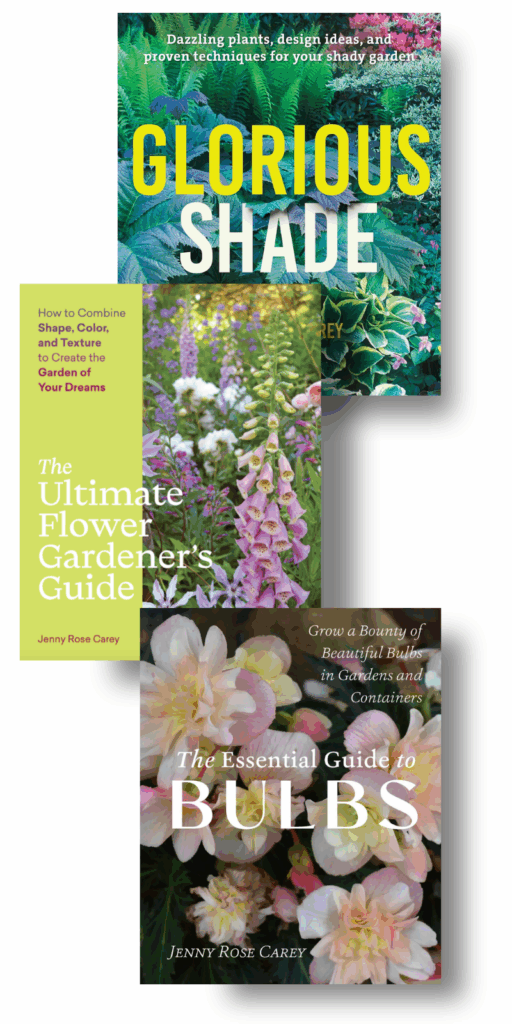
Not only are these books an excellent addition to your gardening book collection, I personally sign every book purchased directly from my website as a special thank you.


Leave a Reply