
Dear Gardening Friends,
As I write this, I am sitting out in my garden surrounded by dahlias, cleome, nicotiana, celosia, asters, and zinnias. Early autumn can be one of the most floriferous times in your garden and it certainly has lots of the lovely sunset colors that Louise Bush-Brown refers to in the quote above. Fall gardens sometimes get forgotten in our quest for a perfect spring garden. If you feel that your October garden is somewhat lacking in bloom get your notebook or phone out and make a list of what is looking great in your neighborhood. Think what plants might be good to add to your beds. Find out the names and add them to your flower wish list.

I have always loved this time of year—maybe because the days and nights are cooler. I can get out into the garden and enjoy my flowers. The blooms look brighter now as they are not bleached by the intense sun, and each flower lasts longer. It is a bittersweet enjoyment though, and a little voice in the back of my head says, “enjoy it while you can.” The first frost is coming. I just hope not too soon. The poor tender annuals turn black and mushy overnight, and my mood is black too. It takes me a few days to recuperate and turn my mind to winter gardening.
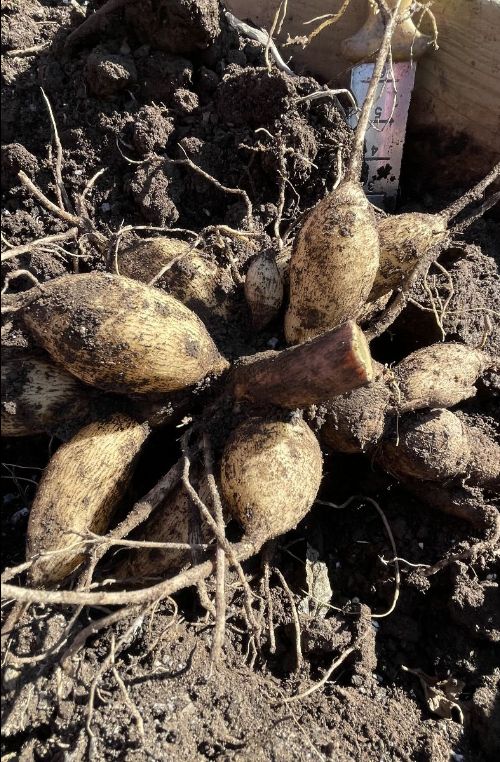
The blog this month concentrates on the way to dig up your dahlia tubers if you live in areas with cold winters. Once they are dug you can save them in a frost-free area over winter and re-plant in the spring after the soil has warmed up.
There is no reason to save your dahlias if you don’t want to. You can compost the whole plant, tuber and all, and buy fresh next year. The price of a new tuber is no more than buying some annual plants.
However, if you do have a place to store them it does save money, and you can be sure of having the ones that you love again next year. They will have multiplied underground during the summer, so you can make more plants for next year. They certainly fit into my strategy of being a frugal gardener.
I hope that you make the most of these fleeting days of early autumn. Pick some flowers and bring them indoors, watch the busy spiders making intricate webs, catch a few falling leaves and put them in your pockets.


P.S. If you did not receive the previous newsletter, I am happy to send it to you—just drop me an email.
If you are reading this because it was passed on by a friend, and you would like to be on the list for this once-a-month email please drop me an email to sign up—you can always unsubscribe.
In the News
I was happy to read this great review of my new book, The Ultimate Flower Gardener’s Guide in Publisher’s Weekly.
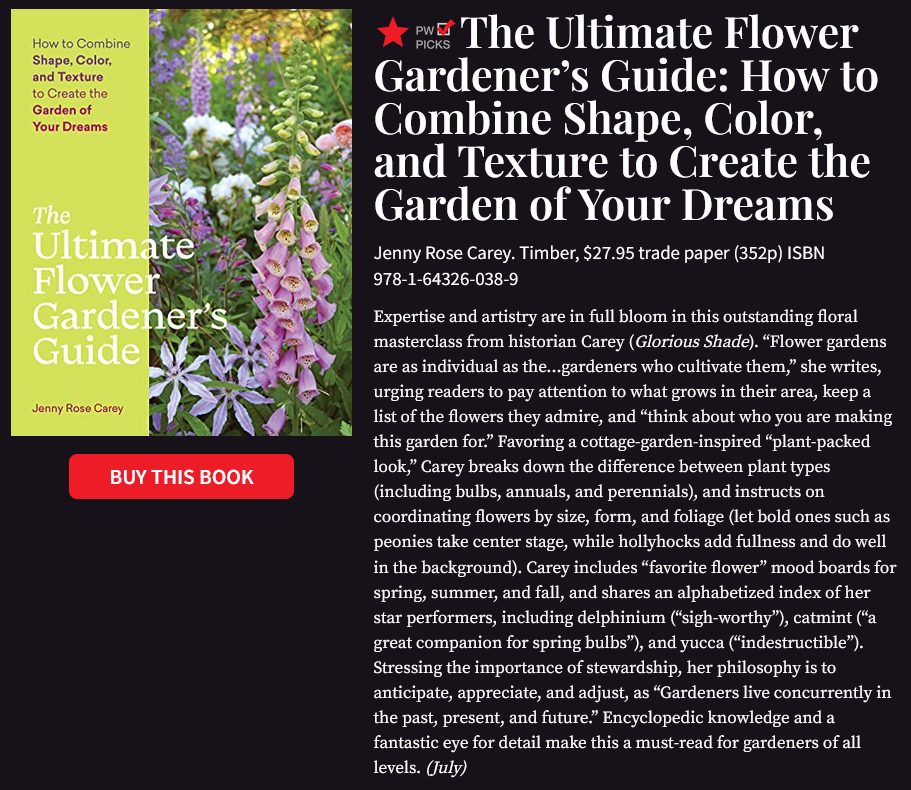
I am behind with my magazine reading and I have a pile sitting ready for when I have a few minutes to spare. I have been waiting to read the cover article in Gardens Illustrated, July 2022 issue. I enjoyed reading about hollyhocks and then flicked through the rest of the magazine. There was my book in the book reviews. I did know it was there as someone had sent me a photo from their copy. It arrives earlier in England than it does here. It was a pleasant surprise.
I was also recently interviewed by Accuweather to give tips on how to keep your garden gorgeous all the way through fall.
Dahlias: How to Dig and
Save Over Winter

There is no real mystery to saving dahlias over winter. It is just a question of not letting them freeze solid. Dahlias are plants from Mexico and South America, so they relish warmth and hate the cold. In warm winters of USDA Hardiness Zone 7 or 8 gardens you may get your tubers to overwinter in the ground but if you get a nasty cold snap, you may lose them.


In the Garden: October Stars

Nicotiana: Flowering Tobacco
This might seem an unusual choice for a garden star because it is not particularly bold in bloom size or shape. However, for months I have been loving the gorgeous fragrance from my nicotiana or flowering tobacco.
The scent is especially strong on the air at dusk. It wafts around as you stroll through the garden and initially you wonder where it is coming from. Once you find the source, you are like one of the special moths that is drawn by this same fragrance to the flower—you cannot leave it alone. A special trip to the nicotiana is a necessary part of the evening walk around the garden. Because of their tubular flower shape, nicotiana is a favorite of hummingbirds.


Growing them from seed is the best way to have these scented wonders in your garden next year. The seed is like dust—so don’t sneeze when you are sowing them. Try to sow them very thinly, with not many in each pot. If sown too close together it is difficult to separate the tiny seedlings. They need to be surface sown, maybe with a little sprinkling of vermiculite or chicken grit on the surface to hold them in place. Nicotiana is a warm-season annual or tender perennial and it can’t take cold, so we sow them inside in potting compost about 6 to 8 weeks before the last frost and keep them at a temperature of around 75 degrees Fahrenheit. The little seedlings are brought outside for a little time each day to get them used to the weather—a process that is called hardening off. They can be gently moved into the garden soil even when quite tiny, as long as the soil is warm.
this year, because nicotiana plants at this time of year really act as a great “mixer and mingler.” Their long flexible stems grow among and between neighboring plants, integrating the flower bed, especially the ones that are lovely and tall. They bring an airy height to your planting. When choosing flowering tobacco types, look at plant height, fragrance, and color.
If you would like scented flowers, try the cultivars Nicotiana ‘Lavender Cloud’ or ‘Perfect Mix’. For shorter plants, go for Nicotiana x sanderae ‘Perfume Mix’, or one of the one-color selections in the Perfume series. Grow them with any annual salvia, zinnia, or celosia.

For a delicate presence on a tall plant and color-changing beauty, grow Nicotiana mutabilis, originally from Brazil. Each flower changes color over time from white to light pink to a deeper pink—all on the same plant. I grow this with cleome (spider flower), also in pink and white. It looks good with Cosmos bipinnatus and Celosia ‘Flamingo Feather’ in white and pink. Similar flowering tobacco cultivars are ‘Marshmallow’ and ‘Bella’—a cross between N. mutabilis and N. alata. For a shorter plant with delicate green tubular flowers, try the fabulous Nicotiana langsdorffii.
Book Club: Flowers for Every Garden

This month’s choice is definitely not mainstream. You may have to go to a horticultural library to find it. There are many reasons for my attachment to this slim volume.
The first connection to this book is through the Pennsylvania School of Horticulture for Women. Louise Bush-Brown was an early graduate of the school in 1916. She went on to become its director from the 1920s to the 1950s. The School of Horticulture became Temple University Ambler, where I studied horticulture and then became Director of the Ambler Arboretum.

Louise taught writing and public speaking at the school and has a wonderful way of expressing herself. A few examples are:
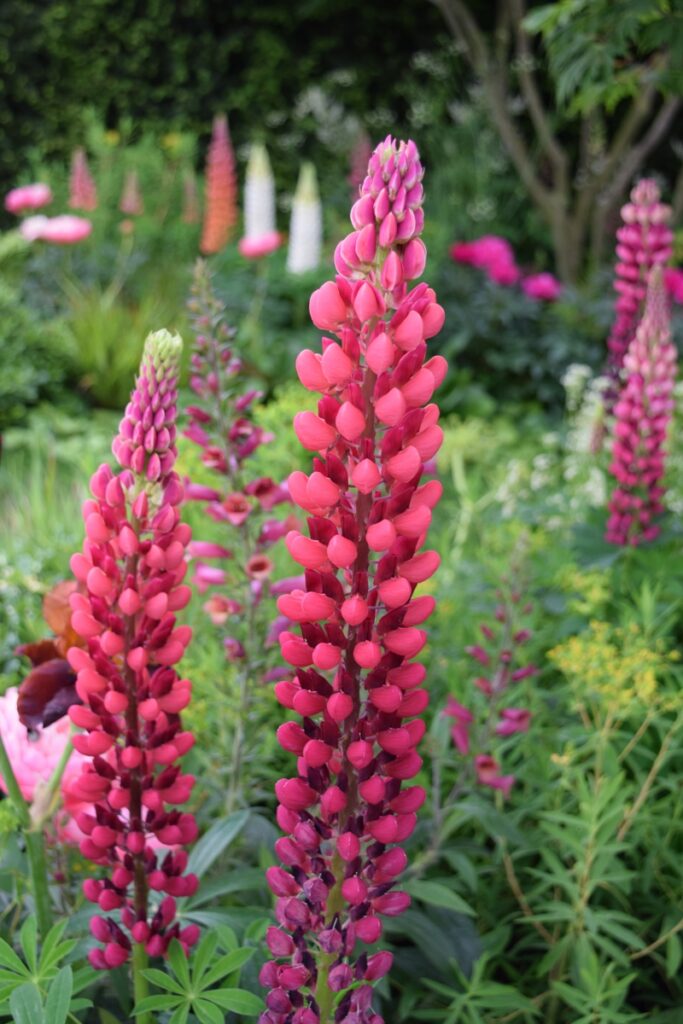
“I do not see why more enthusiasm over lupines is not expressed in the gardening world. I can stand before a flaunting peony quite unmoved, but not so before my lupines. They stir something very deep within my gardening soul.” (page 101)
I too love lupines and struggle to grow them well. I had a lovely pink one that I grew for some years, but it died when I moved it because it bloomed at the same time as the orange poppy next to it, and one year I had had enough of the clashing colors, so they had to go.
Louise says this about purple petunias:
“I think if a gardener were being psychoanalyzed according to the Freudian method, he would, upon being given the word ‘petunia,’ immediately say ‘magenta.’ Somehow these two are very closely associated in the mind, and in order to avoid magenta one usually endeavors to avoid petunias.” (page 107)
I happen to love magenta so on this occasion I differ in my views from Louise. That is what makes gardening fun, as we can each choose what we would like to add to our garden. I wonder what Louise would think of all the petunia colors that we can now buy ninety-five years later. I think that she would be amazed.
Note: I am not sponsored to promote books found in these newsletters. They are featured because I truly love them.
If you like this newsletter, please tell your gardening friends about it. It is easy to subscribe by contacting me via my website.
If you would like to see photos of my garden at Northview and images of my garden travels, please follow me on Instagram @NorthviewGarden and @JennyRoseCarey
Bye for now,




Leave a Reply